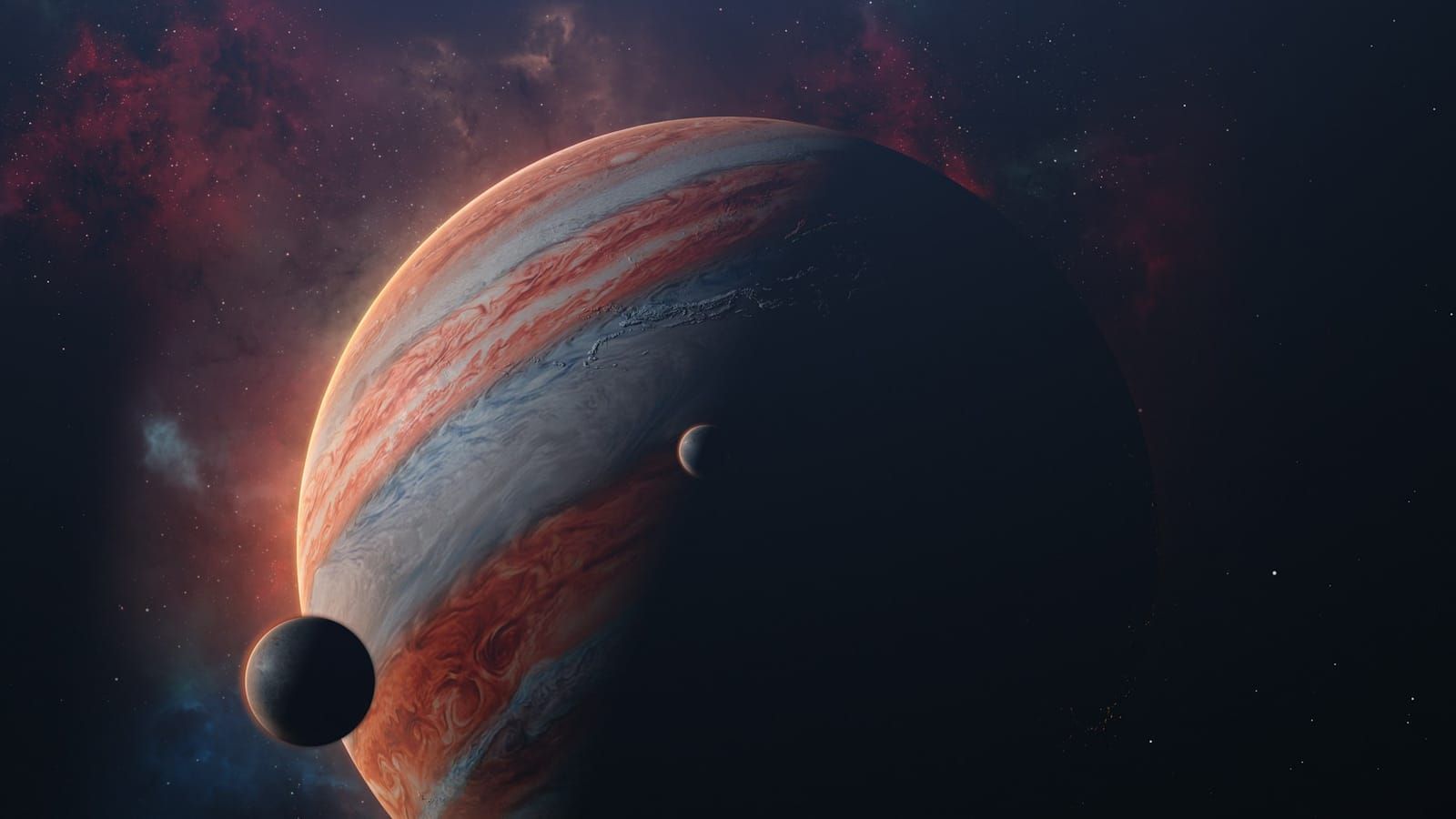
A retrograde is the period when a planet appears to move backwards against the background stars, from east to west instead of its usual west to east, for a few weeks or months. It is an optical effect of orbits: nothing in the sky reverses. Earth and the planet are moving at different speeds, and when one overtakes the other the slower one seems to slide backwards for a while, the way a car you pass on the motorway seems to drift back even though it is still going forward.
This article explains the astronomy in enough detail to see why it happens, lists how often each planet does it, and then takes the symbolic reading seriously on its own terms: what people mean when they say a retrograde is a time to review, and how to use that without letting it run your month.
The astronomy: why a planet seems to go backwards
All the planets orbit the Sun in the same direction. Seen from Earth over many months, each one moves slowly eastward against the stars. But Earth is moving too, and the inner planets move faster than we do while the outer ones move slower.
For an outer planet like Mars, Jupiter or Saturn, the retrograde happens when Earth, on its faster inner orbit, catches up and passes it. For a few weeks or months around that moment our line of sight swings, and the planet appears to loop backwards before resuming its forward motion. This always happens when the planet is roughly opposite the Sun in our sky, which is also when it is closest and brightest. A retrograde Mars is a Mars you can see all night.
For an inner planet, Mercury or Venus, it is the planet that does the overtaking, on the inside, as it passes between Earth and the Sun. Mercury’s orbit is small and fast, so this happens about three times a year; Venus’s is larger, so about every nineteen months.
The moments when the planet seems to stop and reverse are called stations: it stations retrograde at the start and stations direct at the end. Around a station the planet appears almost motionless against the stars for several days.
The Sun and the Moon never go retrograde. The Sun is what we orbit, and the Moon orbits us; neither can be overtaken.
How often, and for how long
Approximate figures. Astronomical almanacs such as the US Naval Observatory and planetarium software give exact dates for any year.
| Planet | How often | How long |
|---|---|---|
| Mercury | about 3 times a year | about 3 weeks |
| Venus | about every 19 months | about 6 weeks |
| Mars | about every 26 months | about 2 to 2.5 months |
| Jupiter | once a year | about 4 months |
| Saturn | once a year | about 4.5 months |
| Uranus, Neptune | once a year | about 5 months |
Two things follow. First, retrogrades are ordinary: on most days of the year at least one planet is retrograde, and the slowest planets spend around 40 percent of their time that way. Second, the famous one, Mercury, is the shortest and most frequent, which is partly why it gets the attention: it comes round often enough to blame things on.
The symbolic reading
Modern astrology reads a retrograde as a planet whose themes turn inward or go over old ground; the older tradition simply counted a retrograde planet as weakened. The prefix is re-. Review, revisit, revise, repair, reconnect, rest.
What the themes are depends on the planet. Mercury, in the tradition, stands for communication, travel and the small machinery of daily life, so a Mercury retrograde is read as a few weeks when messages are worth re-reading, plans are worth re-checking and old conversations come back round. Venus stands for relationships and what we value, so a Venus retrograde is read as a time when old attachments and old tastes resurface. Mars stands for drive and conflict, so a Mars retrograde is read as a time when pushing forward works less well than regrouping.
Read that way, a retrograde is a theme for a few weeks, not a warning. The useful question is not “what will go wrong?” but “what in this area would benefit from a second look?”. That question is worth asking a few times a year whether or not Mercury is doing anything, and the retrograde is a decent reminder to ask it.
There is a cheap version of this and an expensive one. The cheap version: during Mercury retrograde, I will re-read the email before I send it. The expensive version: I will not sign anything for three weeks. The first costs you ten seconds and occasionally saves you from a typo. The second costs you three weeks.
What a retrograde is not
Worth saying plainly, because the internet does not.
- It is not a physical influence. The planet is doing exactly what it always does. No signal, force or field changes. There is no evidence that technology breaks more, or flights are delayed more, in retrograde weeks; if it feels that way, it is probably because you are counting.
- It is not a prohibition. No reputable tradition says you cannot start, sign, buy or travel during a retrograde. The reading is “be more careful than usual”, and being careful is compatible with doing things.
- It is not rare. Something is almost always retrograde. If it were a reason to stop, you would never start.
- It is not personal. Mercury retrograde happens to everyone at once. How it meets your own chart is a finer question for someone reading a birth chart, but the headline event is shared.
How to use one
If you would like to take the symbolic reading as a lens, three habits make it useful rather than nervous.
- Pick the planet’s area and re-do one thing in it. Mercury: re-read, re-confirm, re-organise. Venus: reconnect with someone, or revisit what you actually enjoy. Mars: review a plan before pushing it. One thing, not a regime.
- Treat things that come back as material. An old friend writes, an old project resurfaces, an old argument replays. The retrograde reading says: this is the kind of thing that comes back now. Look at it before you answer it.
- Note the station days. The few days around the start and end of a retrograde are when the tradition says the theme is loudest. If one of them lands on a day when everything feels stuck, that is at least a story to tell about it, and often a reason to wait a day.
And then live the month. The retrograde is a few weeks of a planet’s apparent backward drift. You are allowed to move forward through it.
Where this lives in Cosmia
Cosmia lists the days when a planet stations retrograde and direct among the Key Dates in its Calendar, and a retrograde shows up among the day’s Cosmic Facts for as long as it lasts; in the days around its station it can lead the Day Theme, read the way this article reads it: as a stretch of days that suits re-doing rather than a reason to stop. The idea, a theme to use rather than an event to fear, runs through the whole app; see what is a cosmic guide. For the other common pieces of sky vocabulary, start with Sun, Moon and rising sign and ingresses and aspects.