A full moon reflection is a short look at the first half of the lunar cycle, taken on or near the night the Moon is full. The full Moon falls about fourteen or fifteen days after the new Moon, which makes it the midpoint rather than the finish line: the moment when whatever started at the new Moon has had two weeks to grow and is finally easy to see. The reflection is a check-in, not a ceremony. Three questions and ten minutes are enough.
This article explains why the full Moon suits looking rather than deciding, gives the three questions, and says what to do with what you find, because the two weeks after the full Moon are where the finding turns into something.
What the full Moon is
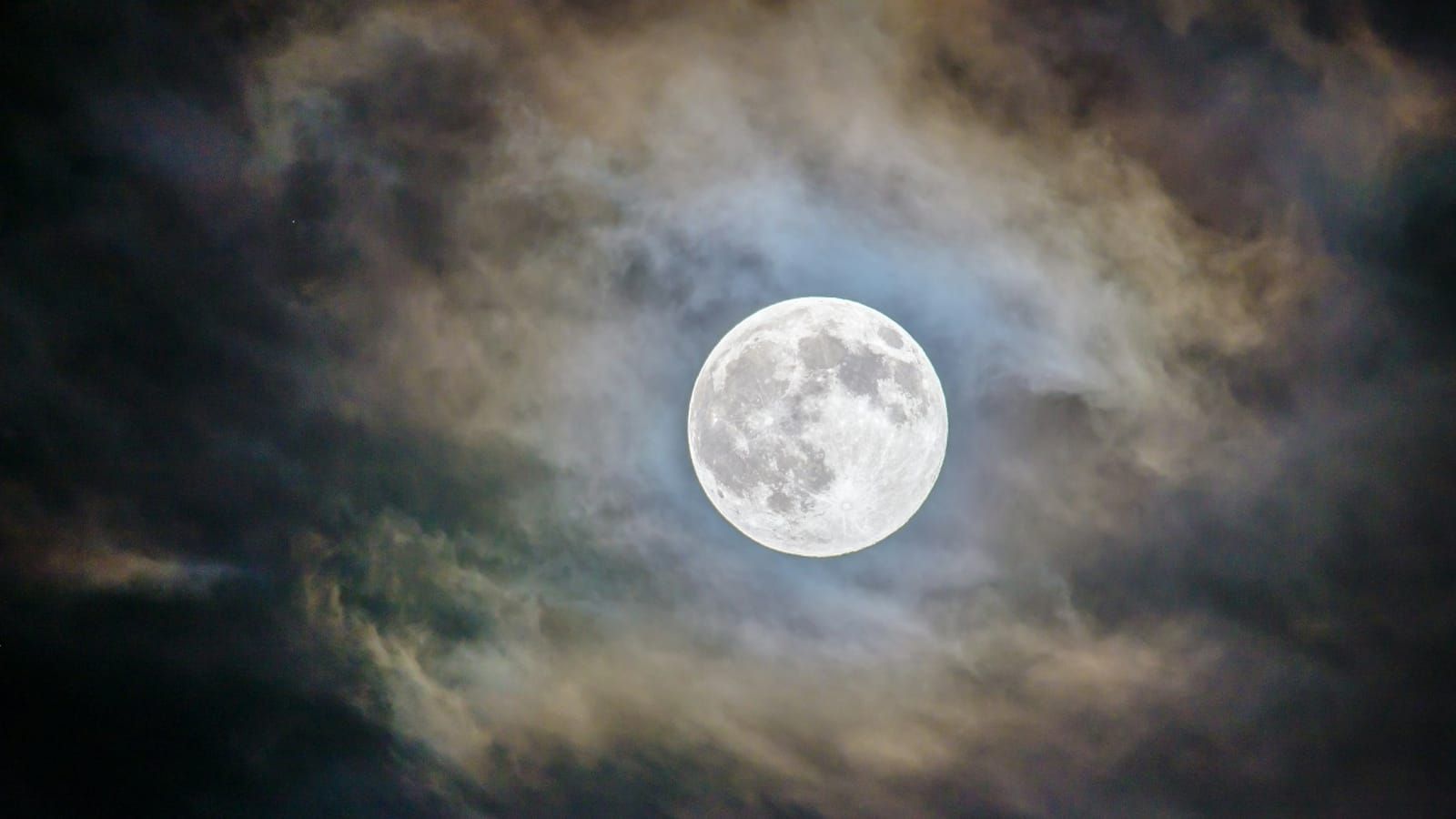
Astronomically, the full Moon is the moment the Moon sits on the opposite side of Earth from the Sun, so we see its whole lit face. It rises in the east around sunset, stays up all night and sets around sunrise, which is why it is the one phase everyone notices: it is there whenever you look. To the eye it looks full for about three nights.
Two details worth knowing because they come up. A supermoon is a full Moon near the Moon’s closest point to Earth; it is a little larger and brighter, and nothing else changes. A lunar eclipse can only happen at a full Moon, when the Moon passes through Earth’s shadow, and only a few times a year. Everything else about full Moons, the names like Harvest Moon, the folklore about hospitals and sleep, is culture rather than astronomy, and the research on mood and sleep has found little that holds up. The full Moon is bright. That is the honest sum of its effect.
So why reflect on it? Because it is the easiest day of the month to remember, and because it sits exactly where a check-in belongs.
Midpoint, not ending
If you set an intention at the new Moon, two weeks is about how long it takes to find out what it meant. The first week is usually too early: nothing has happened yet. The third and fourth weeks are too late to adjust. The full Moon lands in the middle, with half the cycle still ahead.
That is also the argument against the popular framing of the full Moon as the time to release and let go. Letting go is the work of the waning Moon, the two weeks between full and new, and it goes better when it follows a clear look. Release first and you tend to release the wrong thing. The full Moon’s job is the look.
There is a longer version of how the whole cycle fits together in the eight Moon phases. For now: new Moon decides, full Moon sees, waning Moon finishes.
Three questions
Sit with them in any order, for about ten minutes, somewhere you can see the Moon if you like. Write the answers down; they are the raw material for the second half of the cycle. For more angles, by area of life and by the pair of signs the full Moon lights up, see full moon journal prompts.
1. What has become visible?
Not what went well or badly: what can you see now that you could not see at the new Moon? A project’s real size. Which part of a plan you have been avoiding. That a tiredness you blamed on work is about something else. The full Moon question is a lighting question. Something is lit that was not.
2. Does the direction still fit?
If you set an intention: is it still the direction you want to face? Three answers are all fine. Yes: carry on. Yes, but it means something different now: rewrite it in one line. No: set it down, and let the second half of the cycle be lighter. If you did not set an intention, ask instead what the last two weeks had a lot of, and whether you want more or less of it.
3. What is one thing worth saying out loud?
Full Moon days are good for conversations because things are visible, and a lot of what the first two questions turn up is a sentence you have not said to someone. Not a confrontation: a sentence. “I need more time on this.” “That meant a lot.” “I am not sure I want to keep going.” Choose one. Saying it is optional; knowing which one it is, is the reflection.
What to do with the answers
The answers are not the end. They set up the waning half of the cycle:
- Keep what the first question showed is working. Write it somewhere you will see it in the fourth week, when energy is low and it is easy to forget what was good.
- Finish one thing that the light showed is nearly done. Waning Moon days, from here to the last quarter, tend to suit closing loops.
- Release what the second question showed no longer fits, but after the full Moon rather than on it. Give it a day. Most things that need dropping are easier to drop on a Tuesday than on a bright night with a lot of feeling in it.
If that is too much structure, do only the first question. A monthly habit of writing down one thing that became visible is already more reflection than most months get.
A note on intensity
Many people report that full Moon days feel louder: more feeling, less patience, a harder time sleeping. Whether the Moon has anything to do with it, the pattern of expectation is real enough to plan around. Two suggestions. Treat the full Moon as a day for noticing rather than deciding; the decisions keep until the Moon starts to wane. And if the night is bright and sleep is slow, that is a reasonable moment for the reflection, since you are awake anyway.
Neither is a rule. Some full Moons pass unnoticed. That is allowed.
Where this lives in Cosmia
Cosmia marks the full Moon with a Full Moon Check-in at the bottom of the Today screen, next to the Evening Reflection, for the whole day: a short pause on what has shown up in the first half of the cycle. Anything you write in the Journal that day can come back at the end of the cycle in the Cycle Recap, next to the Cycle Intention you set at the new Moon, so the full Moon look and the new Moon decision end up on the same page. If a monthly check-in is the kind of reflection you would actually keep, that is the shape it has there. The approach as a whole is described in what is a cosmic guide.