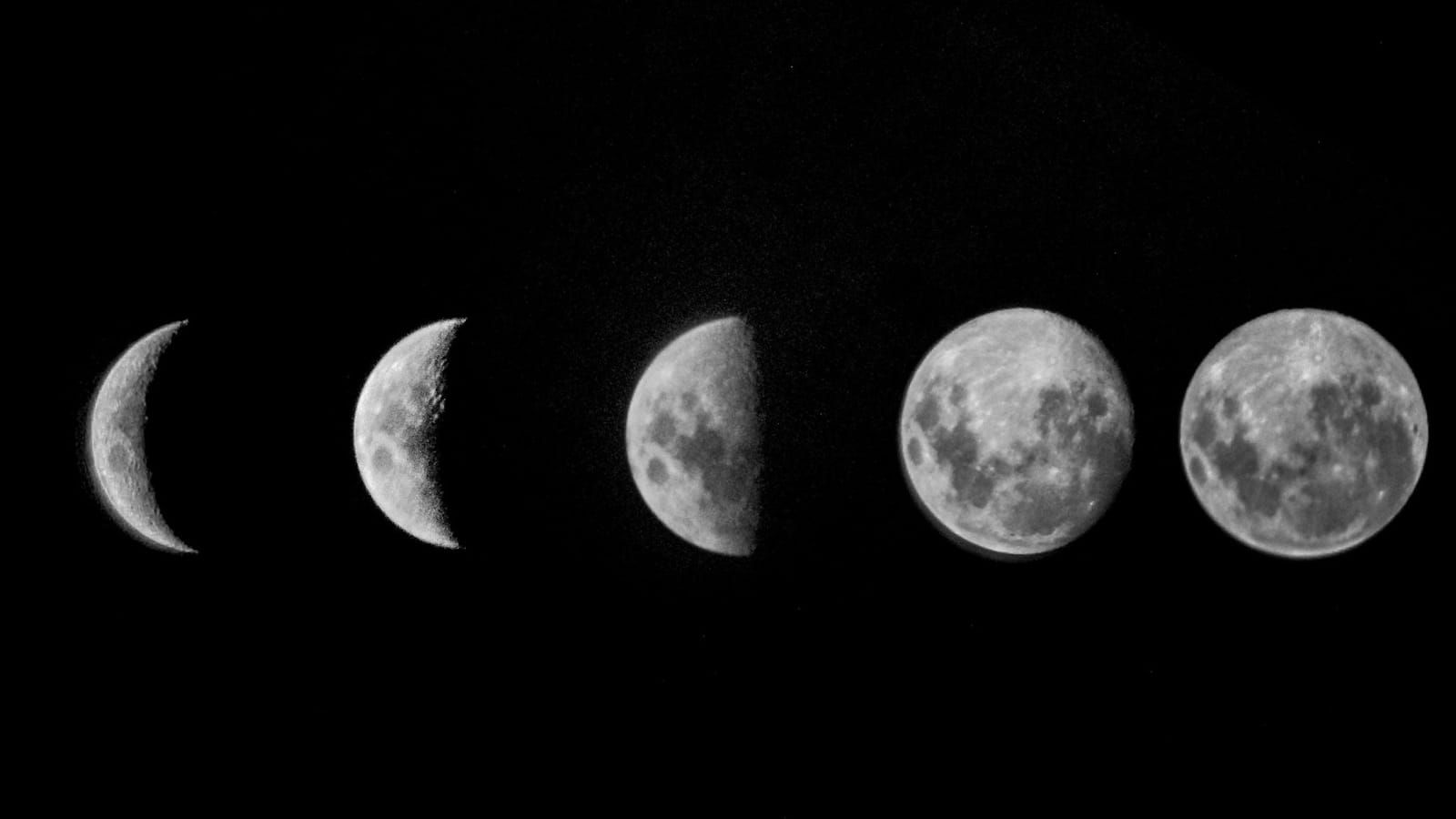
The Moon passes through eight phases in a cycle of about 29.5 days: new Moon, waxing crescent, first quarter, waxing gibbous, full Moon, waning gibbous, last quarter and waning crescent. The first half of the cycle, when the lit part grows, is called waxing; the second half, when it shrinks, is called waning. Each phase has a different look in the sky, a different time of day when you can see it, and, if you like to live with the cycle as a rhythm, a different kind of day it tends to suit.
This article walks through all eight, in order, with the practical side first. The astronomy is kept to what you can check by looking up.
What a Moon phase actually is
The Moon makes no light of its own. What you see is sunlight on its surface, and how much of the lit half faces Earth depends on where the Moon is in its orbit. When the Moon sits between Earth and the Sun, its lit side faces away from us and we see almost nothing: that is a new Moon. Two weeks later, when Earth sits between the Moon and the Sun, we see the whole lit side: a full Moon. Everything else is in between.
Four of the phases are exact moments, the same instant everywhere on Earth: new Moon, first quarter, full Moon and last quarter. Astronomers publish those moments to the minute, and sources such as NASA and the US Naval Observatory list them for every month. The other four phases, the crescents and the gibbous phases, are names for the days between those moments.
One consequence is easy to miss. Because a principal phase is an instant, the calendar day it lands on depends on your time zone. A full Moon at 02:00 in London is still the evening before in Los Angeles. If a calendar and a friend abroad disagree about the date of a full Moon, both can be right.
The eight phases, one by one
For each phase: what it looks like, when to look, what the days around it tend to suit, and one question to carry. The suggestions are a way of using the rhythm, not a forecast. Take what fits and leave the rest.
1. New Moon
In the sky: nothing, or nearly nothing. The Moon rises and sets with the Sun and is lost in its glare. The day after, a thin sliver may appear low in the west just after sunset.
Good for: beginnings that are still private. Naming what you want from the next few weeks before telling anyone. Clearing a desk, a calendar, an inbox.
Be mindful of: rushing to act. The new Moon is a seed, not a sprout. Many people find it is a better day for deciding what matters than for launching it.
A question: if the next four weeks had one theme, what would I want it to be?
In Cosmia, a new Moon opens a new Lunar Cycle: a theme for the cycle and an optional Cycle Intention. More on that in new moon intentions.
2. Waxing crescent
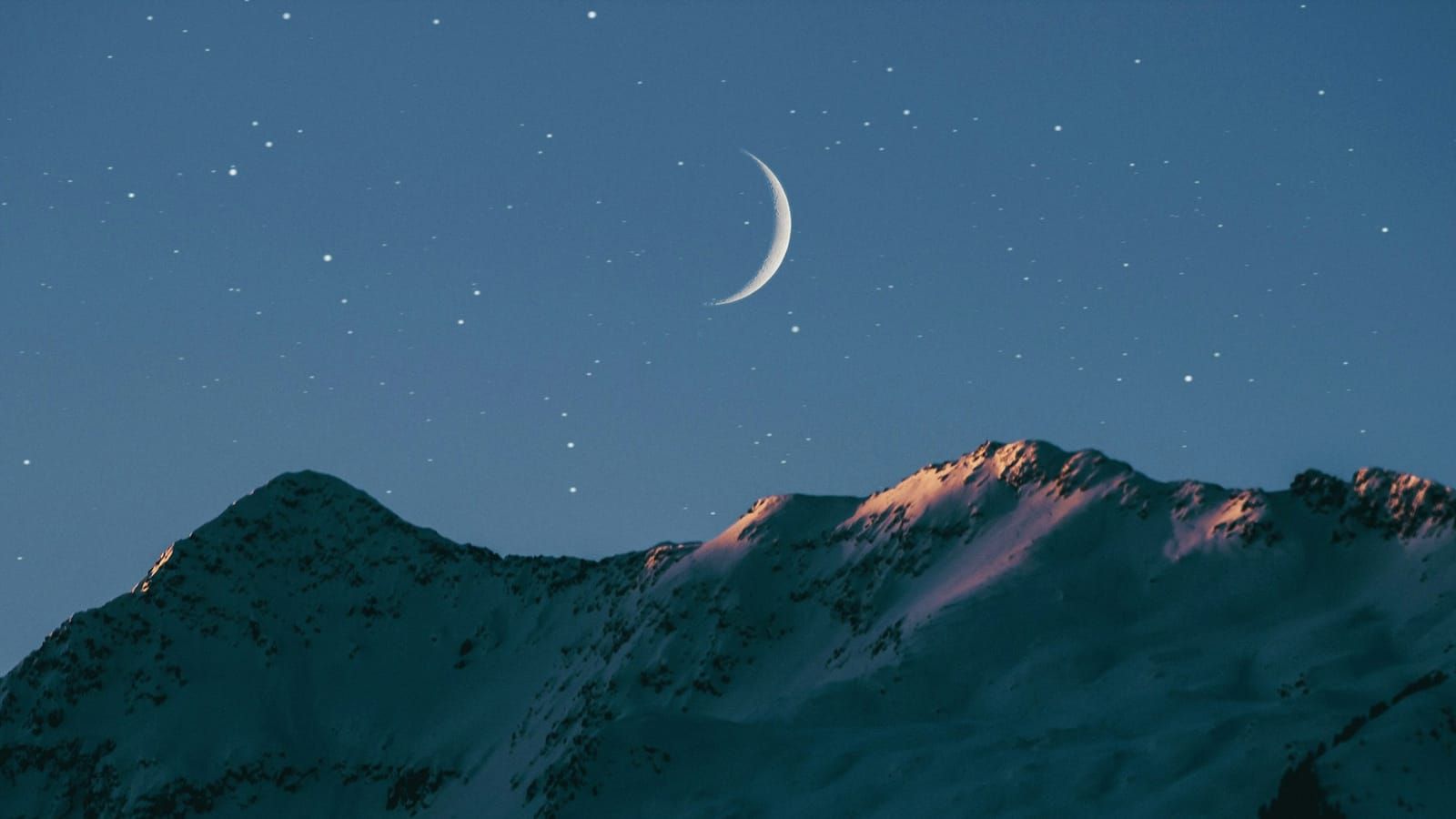
In the sky: a thin curve in the western sky after sunset, setting a little later each evening. In the northern hemisphere the lit edge is on the right; in the southern hemisphere, on the left.
Good for: first steps. Small, concrete, slightly awkward ones: a message, a first draft, a first appointment. Gathering what you need.
Be mindful of: judging the result. A crescent is a few days old. So is whatever you started.
A question: what is the smallest version of the thing I decided on?
3. First quarter
In the sky: half lit, high in the sky at sunset, setting around midnight. The name confuses people: it is a quarter of the way through the cycle, not a quarter of the Moon.
Good for: the first real push, and the first real obstacle. Deciding whether to adjust the plan or hold the line. Asking for help.
Be mindful of: the urge to abandon. Around the first quarter the gap between the idea and the work tends to show. That is a normal part of the cycle, not a verdict on the idea.
A question: what is getting in the way, and is it something to fix or something to accept?
4. Waxing gibbous
In the sky: more than half lit, rising in the afternoon, bright through most of the night. “Gibbous” simply means humped.
Good for: refining. Editing instead of drafting, tidying loose ends, checking the details before something goes out.
Be mindful of: impatience. The full Moon is a few days away and things can feel almost done. Almost is a fine place to be for a couple of days.
A question: what would make this good enough, rather than perfect?
5. Full Moon
In the sky: fully lit, rising around sunset in the east and visible all night. The one phase everyone notices.
Good for: seeing clearly. Looking at what has grown since the new Moon and what has not. Conversations that need light on them. Celebrating something small.
Be mindful of: intensity. Whatever has been building, in a project or a mood, tends to be loudest here. Full Moon days are often better for noticing than for deciding.
A question: what has become visible that I could not see two weeks ago?
Full Moon is the midpoint of the cycle, which is why Cosmia pauses here for a short Full Moon Check-in. There is a whole article on full moon reflection.
6. Waning gibbous
In the sky: still mostly lit, rising later each night, often still visible in the morning sky after sunrise.
Good for: sharing what you learned. Giving feedback, writing things down, passing things on. The pace eases.
Be mindful of: restlessness. In the reading, the push of the waxing weeks turns inward after the full Moon, and that can feel like a loss of momentum. It is a change of direction.
A question: what did the last two weeks teach me that is worth telling someone?
7. Last quarter
In the sky: half lit again, but the other half. It rises around midnight and is high in the morning sky, which is why many people see a daytime Moon in this phase.
Good for: releasing. Dropping what did not work, forgiving what went wrong, closing accounts. Reviewing before the next cycle begins.
Be mindful of: harsh self-review. Letting go is not the same as writing off. A last quarter review can be as simple as “that did not fit; next.”
A question: what am I still carrying that belongs to the last cycle?
8. Waning crescent
In the sky: a thin curve in the east before sunrise, fading each morning until it disappears into the new Moon. Sometimes called the balsamic or dark Moon.
Good for: rest. Low-stakes days, sleep, unstructured time. Noting ideas for the next cycle without acting on them yet.
Be mindful of: forcing a start. A new idea often shows up in these days; many people prefer to note it and act on it at the new Moon.
A question: what could I leave undone until the new Moon?
Waxing and waning, in one line
If the eight phases are too many to hold, hold two. From new to full the Moon is waxing, and those days tend to suit building. From full back to new it is waning, and those days tend to suit finishing. There is a separate piece on waxing and waning, including what the two halves look like in a working week.
A cycle, not a list of days
Astronomically, the phases are a loop. Practically, they work best as chapters. A theme set at the new Moon, a check-in at the full Moon, a short review before the next new Moon: three moments a month, which is a rhythm most people can keep without a calendar reminder. Questions for writing at each of the eight phases are in journal prompts for every Moon phase. How long the whole loop takes, and why the number 29.5 is only an average, is in how long is a lunar cycle.
Two things the rhythm is not. It is not a schedule: a waning Moon does not forbid starting something, it just suggests that a start may take more effort than it would in two weeks. And it is not a cause: there is no consistent evidence the Moon changes your mood or your sleep. What it offers is a shape for ordinary days. The lit part grows and shrinks, and you can use that as a reminder that your own weeks have a shape too.
How to find today’s phase
Three ways, in order of charm:
- Look up. After sunset, a Moon in the west is waxing; before sunrise, a Moon in the east is waning. Half lit at dusk is first quarter, half lit at dawn is last quarter.
- Check a table. NASA and the US Naval Observatory publish the exact moments of the four principal phases, and most Moon calendars add the Moon’s sign (a two-and-a-half-day mood) and its void-of-course hours; timeanddate converts them to your local time.
- Open the app. Cosmia shows the phase and the day of the Lunar Cycle on the Day Cover, drawn the way the Moon looks from where you are, with the rest of the day’s sky under it.
Where this lives in Cosmia
The Moon phase is the first thing on Cosmia’s Today screen: the phase, the day of the cycle and the Moon’s sign sit above the Day Theme, and the Calendar tab shows the whole month of phases at a glance. A new Moon opens a cycle, a full Moon pauses it, and the end of the cycle closes it with a recap. If living with the Moon as a rhythm sounds like something you would like to try, that is what the app is built around. The idea behind it is in what is a cosmic guide.