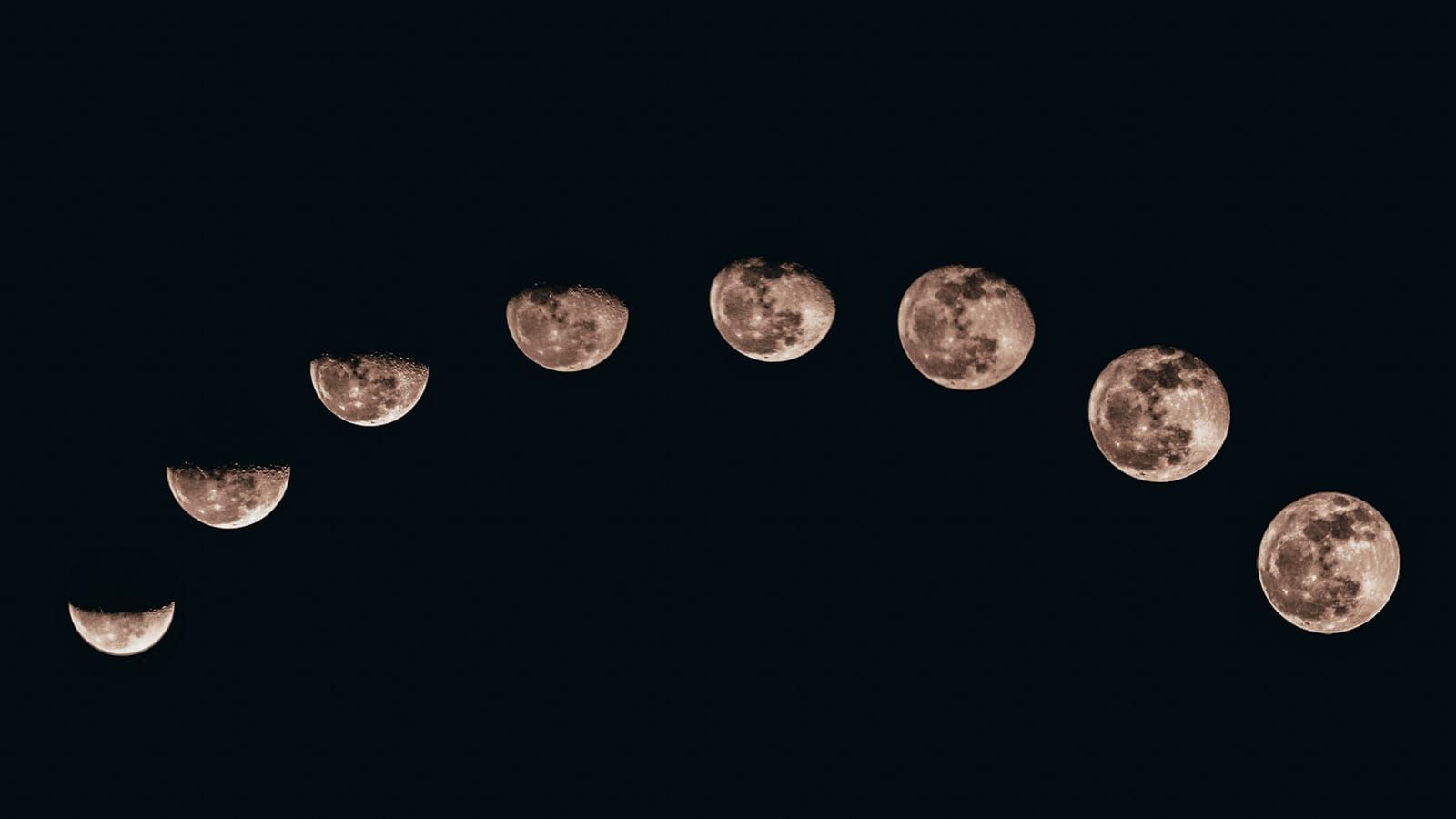
A lunar cycle, the time from one new Moon to the next, lasts 29.53 days on average: 29 days, 12 hours and 44 minutes. Any particular cycle can run six or seven hours short or long of that, so “29.5 days” is a rounding, not a constant. The cycle is longer than the Moon’s actual orbit of Earth, which takes 27.3 days, because Earth is moving too and the Moon needs an extra two days or so to line up with the Sun again.
That is the answer. The rest of this article is for anyone who wants to know why the numbers are what they are, how the cycle fits into a year (badly), and what the length means if you use the cycle as a rhythm rather than as astronomy.
Two months, two lengths
Astronomers measure the Moon’s month in more than one way, and the two that matter here are easy to confuse.
The sidereal month is one orbit of Earth measured against the stars: 27.32 days. If you noted which star the Moon sat next to tonight, it would be back beside that star in 27 days and 8 hours.
The synodic month is one cycle of phases, new Moon to new Moon: 29.53 days. The phases depend on where the Moon is relative to the Sun, not the stars, and in 27 days Earth has moved about 27 degrees along its own orbit. The Sun’s position in our sky has shifted by that much, so the Moon has to travel an extra 27 degrees to get back between us and the Sun. At the Moon’s pace of about 13 degrees a day, the catch-up takes a little over two days. 27.3 plus 2.2 is 29.5.
When people say “lunar cycle” or “lunar month” they almost always mean the synodic one, the cycle of phases. That is the one this article is about.
Why it is not exactly 29.5
The 29.53 figure is a mean. Real cycles vary from about 29.3 to 29.8 days, six to seven hours either side of the mean, for two reasons.
First, the Moon’s orbit is an ellipse, so it moves faster when it is closer to Earth and slower when it is further away. Where the new Moon falls on that ellipse changes how quickly the Moon covers the extra distance.
Second, Earth’s own orbit is an ellipse too, so the rate at which the Sun’s apparent position shifts varies through the year: faster around early January, slower around early July. The catch-up distance is therefore not constant either.
The result is that if you want the exact moment of a given new or full Moon, you need a published table rather than arithmetic. NASA and the US Naval Observatory publish them; timeanddate converts them to local time. For a rhythm, 29.5 is plenty.
The cycle and the calendar
Twelve synodic months add up to 354.37 days, about eleven days short of the solar year of 365.24. That gap is the oldest problem in calendar-making, and the three classic answers are still in use.
- Ignore the Sun. The Islamic calendar is purely lunar: twelve months of 29 or 30 days, so the year is 354 or 355 days and the months drift through the seasons, coming back round every 33 years or so.
- Add a leap month. The Hebrew and traditional Chinese calendars add a thirteenth month seven times every nineteen years, a pattern known since antiquity as the Metonic cycle, because 235 lunar months come to almost exactly 19 solar years. The months stay roughly with the seasons.
- Ignore the Moon. The civil calendar most of the world uses keeps the word “month” and drops the Moon entirely. A calendar month is 30 or 31 days, the phases fall where they fall, and the only lunar survivor is the date of Easter.
One side effect of the mismatch: because 29.53 is shorter than most calendar months, a month will sometimes hold two full Moons. The second is popularly called a blue Moon, and it happens every two to three years. There is nothing astronomically special about it. It is the calendar showing its seams.
The cycle as four weeks
For anyone using the lunar cycle as a rhythm rather than as a measurement, the useful facts are these.
The cycle is about four weeks, roughly a day shorter than a calendar month (a day and a half against a 31-day one), so the new Moon falls about a day earlier each month. It drifts backward through the calendar, which is a nuisance for planning and a feature for attention: it does not line up with the first of the month, the pay cheque or the sprint, so it reads as its own clock.
It has a built-in middle: the full Moon, about 14.8 days in. Few other four-week units come with a midpoint you can see from the garden.
It has four quarters of about a week each, marked by the four principal phases, which is why people who live with the cycle talk about “the week after the full Moon” the way others talk about the second week of the month. The eight phases fill in the days between; the waxing and waning halves are the two-part version.
And it repeats. Whatever you set at a new Moon has a fixed horizon, 29 or 30 days off, after which the slate clears and the next cycle starts from wherever you are. That is the argument for a new moon intention over a resolution: the deadline is in the sky.
A few other lunar numbers
In case you meet them.
| Number | What it is |
|---|---|
| 27.32 days | Sidereal month: one orbit against the stars |
| 29.53 days | Synodic month: one cycle of phases |
| 27.55 days | Anomalistic month: closest point to closest point; why some full Moons are “super” |
| 27.21 days | Draconic month: crossing to crossing of Earth’s orbital plane; why eclipses come in seasons |
| 12.37 | Synodic months in a solar year |
| 18.6 years | How long the two points where the Moon’s orbit crosses Earth’s take to circle the zodiac; why eclipse seasons drift |
None of these are needed to live with the Moon. They are here because once you start asking how long the cycle is, these are the next questions, and they have answers.
Where this lives in Cosmia
Cosmia is built on the synodic cycle. A new Moon opens a Lunar Cycle with a Cycle Theme and an optional intention; the full Moon brings a short check-in about fifteen days later; the last days before the next new Moon close the cycle with a recap of what you chose, did and wrote. The Calendar tab shows the cycle as a month of phases, and the Day Cover shows which day of the cycle today is, so “day 22” becomes a familiar place rather than a number. If a four-week rhythm with a beginning, a middle and an end sounds more livable than a calendar month, that is the shape the app keeps. The approach as a whole is in what is a cosmic guide.