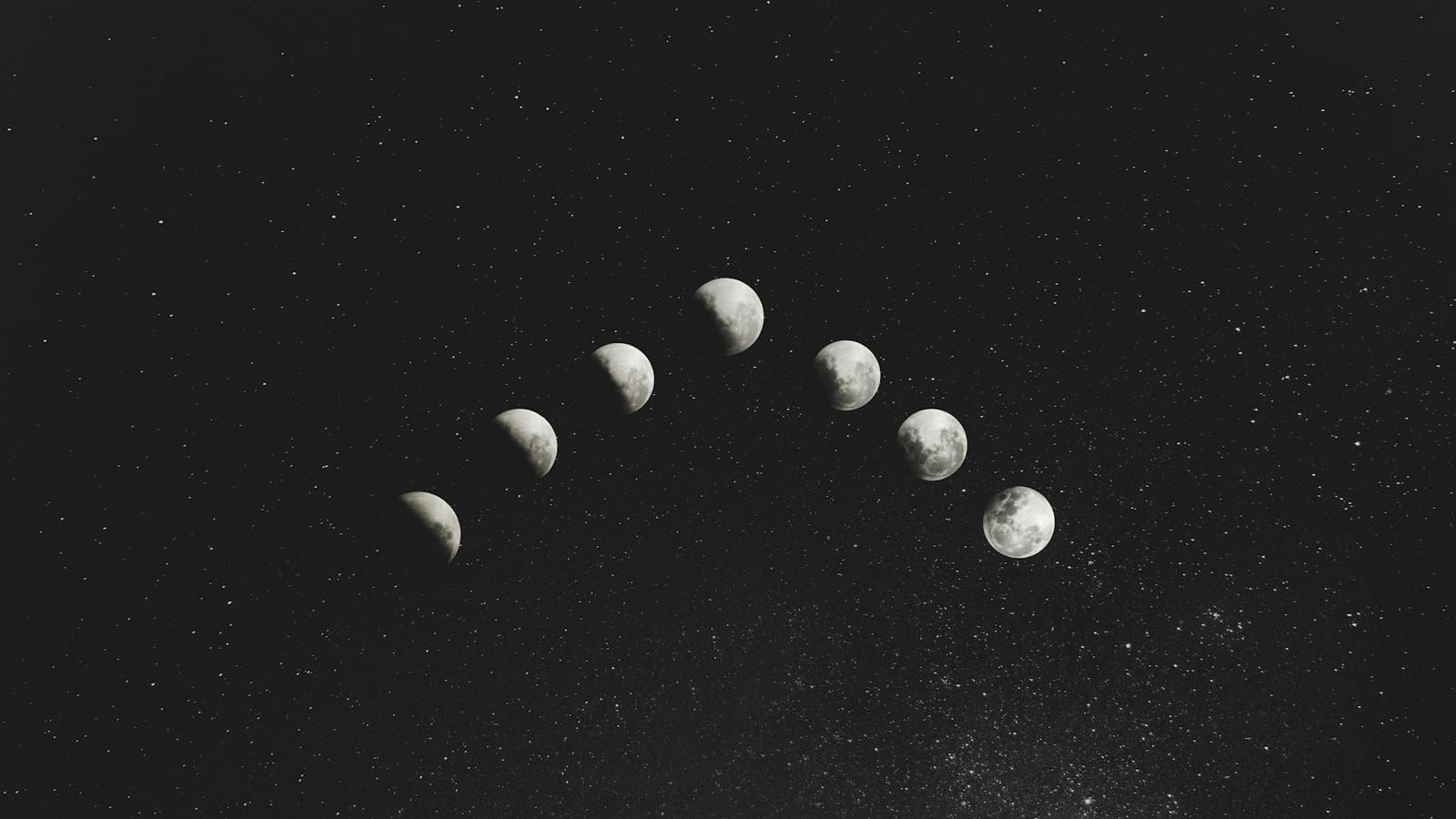
Moon phase journal prompts give you a question or two for each of the Moon’s eight phases, so that a lunar cycle of about 29.5 days becomes a month of short entries with a shape: you start at the new Moon, build through the waxing weeks, look at the full Moon, and finish and rest as the Moon wanes. You do not need all eight. Writing at the new Moon and the full Moon is a complete practice; the other phases are there for weeks when you want more.
Each phase below has a line on what it looks like in the sky, a line on what it is traditionally said to suit, and four or five prompts. The astronomy behind the phases is explained in the eight Moon phases.
How a phase journal works
The Moon goes from new to full in about two weeks and back again in another two. On average each phase covers three and a half to four days: the four main phases fall on a single day each, and the in-between phases fill the days around them. A simple rhythm:
- Two entries a cycle: new Moon and full Moon. Ten minutes each.
- Four entries: add the first and last quarter. Roughly one a week.
- Eight entries: one per phase, a few lines each.
Keep all of them on the same page or in the same notebook section, dated, with the phase written at the top. By the end of the cycle you have a short story of four weeks, which is easier to read back than thirty daily entries.
New Moon
In the sky: nothing, or almost nothing. The Moon is between Earth and the Sun and its lit side faces away. Said to suit: beginnings and choosing a direction.
- What do I want to take from the last cycle into this one?
- Which part of my life keeps coming up when I am not trying to think about it?
- If the next four weeks had a one-word title, what would it be?
- What would I like to read back at the full Moon?
The long list, sorted by area of life and by sign, is in new moon journal prompts.
Waxing crescent
In the sky: a thin curve in the west after sunset, growing each evening. Said to suit: first steps and gathering what you need.
- What is the first small step toward the direction I chose?
- What do I need to start: information, time, a person, a yes?
- What is one thing I could do this week that I would usually put off?
- Who could I tell about this, so that it feels real?
First quarter
In the sky: half lit, high in the south at sunset in the Northern Hemisphere, about a week after the new Moon. Said to suit: decisions, effort and dealing with the first obstacle.
- What has pushed back since the new Moon?
- Which decision have I been waiting to make, and what is missing?
- Where do I need to put in effort, and where am I forcing?
- What would make this week a good one, even if only one thing went right?
Waxing gibbous
In the sky: more than half lit, rising in the afternoon and bright by evening. Said to suit: refining, adjusting and patience before the peak.
- What is working, and how could it work a little better?
- What would I adjust if I let myself change the plan?
- Where am I impatient for a result that needs another week?
- Which detail would I regret not checking before this goes out?
Full Moon
In the sky: the whole face lit, rising around sunset and up all night. Said to suit: seeing clearly, conversations and noticing what has shown.
- What can I see now that I could not see at the new Moon?
- Does the direction I chose still fit?
- What is one sentence I would like to say to someone?
- What am I proud of in the last two weeks?
There are many more, by area of life and by sign pair, in full moon journal prompts, and a three-question routine in full moon reflection.
Waning gibbous
In the sky: still mostly lit, rising later each night, visible in the morning sky. Said to suit: sharing, thanking and taking stock.
- Which result of the first half surprised me most?
- Who helped me lately, and have I let them know?
- What am I keeping from this cycle?
- What did I expect that did not happen, and how do I feel about that?
Last quarter
In the sky: half lit on the other side, rising around midnight and high in the south at sunrise in the Northern Hemisphere, about three weeks after the new Moon. Said to suit: finishing, clearing and turning down what no longer fits.
- What can I finish before the next new Moon?
- Which task could I hand to someone else?
- Which commitment would I not make again?
- What could I clear, physically or on my calendar, to make room?
Waning crescent
In the sky: a thin curve in the east before dawn, shrinking each morning. Said to suit: rest, quiet and letting the cycle end.
- What do I need before the next cycle starts: rest, time alone, a change of scene?
- What am I glad this cycle gave me?
- Which evening this week could I keep completely free?
- What would I like to carry forward, and what would I like to leave here?
- What has been tiring me, and how much of it can wait?
The short version: two questions
If eight sets feel like a lot, waxing and waning Moon splits the cycle into two halves, and two questions cover them. While the Moon grows: what am I building? While it shrinks: what am I finishing?
Where this lives in Cosmia
Cosmia follows the same cycle every day. The Today screen shows the phase and the day of the cycle on the Day Cover, the Day Theme takes its mood partly from the phase, and the Reflect on question gives one prompt for the day. The new Moon brings a Cycle Theme and an optional Cycle Intention, the full Moon a Full Moon Check-in, and the Journal keeps your entries by date, under each day’s theme. More ways to write without making it a project are in how to start journaling and in the daily reflection section.